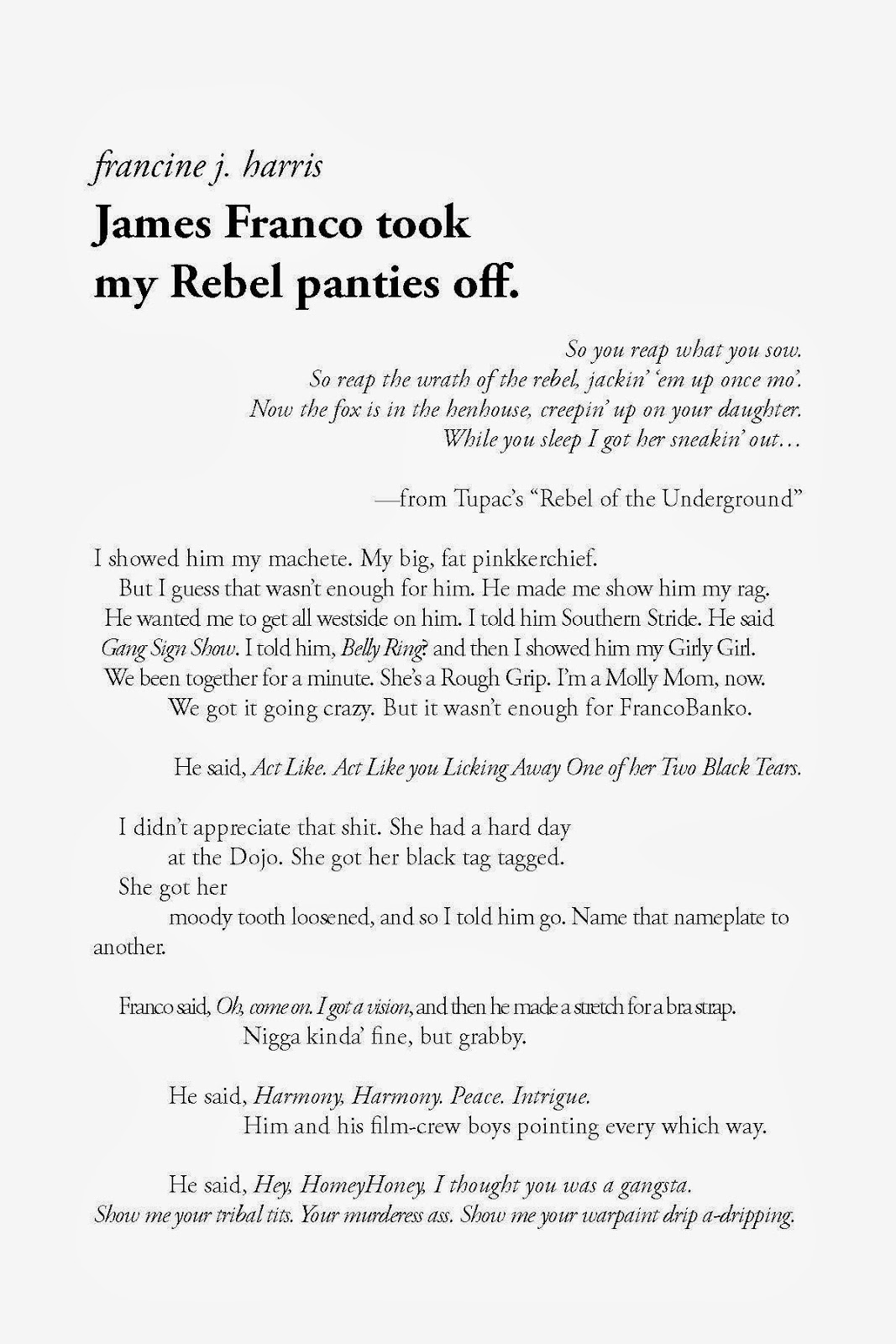
Wednesday, April 10, 2013

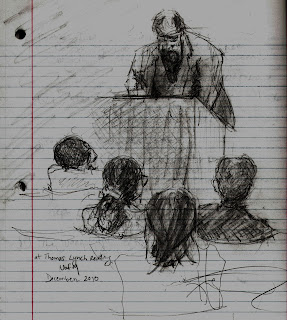
"at Thomas Lynch reading, UofM - December 2010"

I found this drawing today that I did a couple years ago, and thought I'd post it. I know the lady in the ponytail is Eileen Pollack. I think Michael Byers is to her right. I can't remember who's head is cocked in that strange way in the front row, but I remember being fascinated by the pose. 

Sunday, March 24, 2013

The Stream - "A Man Named Pearl"

Tonight I watched the 2006 documentary, A Man Named Pearl. The story is about Pearl Fryar, a topiary artist in Bishopsville, South Carolina. Bishopsville is a small town that Fryar's topiary garden has apparently put "on the map." Tourists come from miles and states and countries away to see the 3-acre artscape. And, in fact, if you google the address to Fryar's garden, not only is Bishopsville on the map, but so is Pearl Fryar. The Google satellite view shows, not only some of his incredible leafy sculptures, but also a shot of the artist himself, cruising along on a John Deere down Broad Acres road.

Ultimately, I love this story. Scott Galloway, as director and producer, codirects and coproduces this documentary about Pearl Fryar, who is not just an awe worthy artist, but seems like a pretty incredible human being. He spends time mentoring youth, cares about his community, and has that kind of can-do attitude that must be a documentarian's wet dream.


I've had this title in my queue for a while on Netflix. I kept not watching it. I think it's because I am suspicious about documentaries (and film in general) about African Americans just now. I'm kind of in a place. I find myself not just disappointed with some of the depictions, but heartbroken. I knew I would like Fryar just from looking at his face in profile on the thumbnail of the movie blurb. I didn't want to be heartbroken.

And, indeed, I had to unclench my teeth a few times during the beginning of A Man Named Pearl. Here's a story about an artist in a small town in South Carolina who taught himself horticulture and landscape art and, with years of daily work, created an incredible garden.


But the term "artist" is not often used about Pearle in this documentary. And it's difficult to tell why, or how that's happened. That's the problem with documentaries. You can never tell if it's the interviewer’s angle you are witnessing, or the people being interviewed, or both. 

In this film, the larger impression of Pearl Fryar is that he is a worker – doing a great job. And doing such a great job, that he gets Employee of the Year (or here it is Bishopville’s coveted Yard of the Month award) which set him on his way. The vicars esteeming his dedication include people such as the Director of the Chamber of Commerce, a news editor, the AME pastor, and a friend named Polly Lafitte, who is clearly a museum curator, but for some reason is not connected, in title, to the museum that has commissioned Fryar’s work, but is only listed as “Friend.”

There are strange moments in this narrative, such as the Commerce Director talking about the money coming in from the tourists in such a fiduciary way that it leaves the viewer wondering if Fryar actually sees any of the moneys that he apparently generates for this local economy. You really can't tell. Coupled with a strange scene of the Waffle House waitress in a rather condescending spiel about how she makes sure Pearl Fryar and his wife "eat for free," one has to wonder what the town allows Fryar to believe about his monetary worth. 

Another troubling aspect of the film is the impetus for Fryar’s art. The response to this notion is put forth by the townspeople, but not entirely challenged by Galloway and crew. It is said several times that Fryar is the son of a sharecropper and grew up in very difficult times. Yet, at a logical point in the sequence of the documentary when it feels time for a viewer to understand what started all this for Fryar, the revelatory human-triumph music kicks in and the dialogue is cut back and forth between Fryar and his younger friend, Lafitte.

Lafitte: "When Pearl first came to Bishopsville … he looked at a house in a particular neighborhood and he really wasn't welcomed there because of his race." 
Fryar:  "I guess it's the same thing you would have anywhere, would be, a problem of uh, I guess really kinda' accepting the fact of someone strange moving into your neighborhood."
Lafitte: “There was the statement made that they didn't really want him in this neighborhood because he wouldn't keep up his yard and that's a racial stereotype that's difficult for anyone to handle."
Fryar:   "It's human nature to look out for whoever look like you. You understand what I mean? And ... there's always gonna’ be those obstacles. The thing about it is to make you strong enough that you don't let those obstacles become what determine where you go".    
Lafitte: "Pearl handled it very, very well in a positive way and said 'I want to do something that is spectacular in keeping up my yard.’"

Thus, we are sort of left with the impression that Fryar’s impetus for his life of art was that Yard of the Month award.

But Fryar, in the way of retrospective, also talks about his father as role model. And I have to think, based on how he talks about him, that much of his art is in honor of his father's hard work – his father the sharecropper, a man with a third grade education, who spent countless hours farming another man's land. From our understanding of sharecropping, we have to imagine that those hours were brutal, exhausting, fruitless and ultimately, artless. 

“One of the things about farming, like you had to work. This was like basically a 24 hour a day job. And when you grow up in that kind of environment where work is the only thing that you have to offer. – if the people felt like you was not a good worker, you couldn't get a farmer to farm [for] the next year to feed your family. So I saw my father go through that." – Pearl Fryar

But the most fascinating, and sometimes troubling aspect of this documentary, is that Fryar is not revered for his artistry, as much as for his function, as an extension, in a strange way, of the town economy, of the church, of the community. Some of this is clearly part of Fryar's philosophy. He calls the topiary garden a "ministry" in an interview with ETV Road Show. He talks about having a daily congregation of tourists. Early on, Fryar says "It wasn't important to me to create a garden. I wanted to create a feeling - that when you walked through, you felt differently than you did when you started." So it's not off the mark to depict Fryar as a man of God and the garden as a kind of spiritual outlet and spiritual center that he wants people to have as a haven of “Love, peace and goodwill.”

And then some of it, it seems, likely just the sort of provincial outlook of a small, southern town. The kind of place that still sees art as a little weird, that thinks largely in terms of use and function. Clearly Fryar is accepted here because he is good for Bishopsville.

Still, I am left a little befuddled at how much face time the AME preacher gets in this documentary. And though it makes sense that the Commerce Director is in the film, they both contribute to a general feeling that Fryar is not an artist, as much as he either, a commodity for the good of the town or someone just doing the work of the church.


How he manages to thrive in a town that does not give him much agency for his creations is honestly mind boggling to me. And here, I start to feel the limits of my rather skeptical, nonchristian ways. I hear something more in the subtext of some of this commentary that, maybe, isn't there at all. Places where it seems like people are trying to minimize Fryar’s artistry, to take the art out of his hands and attribute it to a divine inspiration that they all share. After years of watching Fryar work "morning to night," a neighbor says of the topiary garden, that it was great to see "the miracle happening."

Granted, as I said, this is the perspective of someone who doesn’t follow the church. But there is also a way in which I can appreciate all the brothersisterly love put forth here, both by Fryar, and the communion that others partake in, even if in taking strange credits for his work.

It just seems to be the way things go. A kind of wild and willing faith. A kind of communion. And so, yes, a kind of love.

Tuesday, November 27, 2012

Do You Think I'm Judgmental?

Recently, some of my dear friends implied that I might be a bit judgmental. I was, of course, shocked and dismayed. Then I considered the sources of this strange accusation.  And I had to decide whether or not they were judgmental people making these judgments about my judgmentalness. Then I decided that since I loved them dearly, it was ok that they might be so crude as to make such a horrendously erred and flawed conclusion about my personality. Then I considered whether or not I still loved them anyway, even though they might be erred and flawed. Because if I loved them, that must mean they're good people, (if erred and flawed) and if they're good people, maybe they might be right about the nature of my judgmentals. But, that thought was a little scary for me. So then I thought: Are they? Are they good people? How do I know? And then I thought about all the things I know about these people. Their various acts. And deeds. And accomplishments. And convictions. Their senses of humor. And their funny ways. And I thought about the way they walk. And the way they sit in a crowded room. From across the room. And I thought about what I think every time I see these people. The first thing that comes to mind whenever we meet. Then I decided. They're alright. They're pretty alright. Yeah, they're pretty good, alright people. Yeah, they're pretty great.

Saturday, November 3, 2012

Cynical. I think I mean Mildly Cynical.

The following post is a response to a conversation I initiated on facebook with this status update ...  

ifrancine ij iharris:   
I commented on someone's 'mild cynic' recently and they thought I was being insulting. So I wrote to them: " I think a healthy cynicism is necessary. I believe you can stay optimistic in the face of pessimism, but I dislike rosey views and I dislike 'nice'ness and I dislike people who will do anything, sacrifice anyone, walk away fron anything, deny any form of difficult truth for teh sake of keeping everything 'kosher,' 'upbeat' or 'positive.' I mean I really dislike these people. Lol. I avoid them fervently.
So in order not to be this way - to be a real thinker, to be discriminating, to be honest - doesn't it require a certain amount of cynicism, of skepticism, of approach to any subject, any notion, any 'fact' with a discerning lens? The question for me is always 'What do I make of this?' not 'Does this make me feel good?'
This is maddening to some. And to those folks ... Ah well. We nod and wave in passing.
Mentioning your 'cynical' eye as part of your thought process is my sincere form of flattery.' 
... and then I wanted to share my declaration with the world (of facebook).


... in particular this response from my friend, Nick

Nick Gaudio Ah, hell. Another try:

That people are self-interested is...well, an obvious point. However, cynicism seems to me an outright dismissal of all human interaction as self-interested and "base", flagging all Other Parties as potential threats regardless 
of fact or nuance or circumstance; whereas "discernment" or "shrewdness" allows for a broader scope of understanding of what self-interest can be or mean. 

Why are we having this conversation?
A cynic would say: "You're both trying to appear intelligent," (or something like that) condemning us to simplistic/animalistic impulses; people speak to publicly define self-worth in the Petri Dish of competitive Darwinism, whatever. Look how smart we are, opposite sex! Base urges, etc.
A shrewd person would say: "You're both probably trying to come to some understanding of some greater truth." Of course, that motivation is still in the arena of self-interest, but it smacks of a type of nobility that I hope, at least, is partially true. We're trying to make ourselves feel more assured about a unknown universe and there is some nobility in that. 

Not only that, but to constantly monitor the motivation of Other Parties is an implicit statement that one must -- out of necessity -- constantly monitor all Other Parties (for fear, I suppose, of one's own self-interested being infringed upon). What else is that but unproductive misanthropy? 

Let's say I have three sons and one steals money from my wallet. If I constantly monitor the other two sons, who have not ever (to my knowledge) stolen money, I'm wasting my time. To monitor, however, the thief-son is productive and shrewd. To monitor the other sons as if they are potential thieves is cynical. 

I'm in a bit of a hurry now, so this might not make much sense. I apologize but work calls, you know.
The gist of the whole conversation can be seen in my previous post, or by clicking here:
                       http://routyweed.blogspot.com/2012/11/dont-you-mean-skeptical-not-cynical.html


Dear Nick Gaudio,

Your points are fine. I really love that you (and others like Metta) hold integrity to the intended meaning of our language. You are absolutely right, and I can concede this – that I may use, and have been using, the word incorrectly.

I’ve had this argument before, actually. And so I wonder why I hold to this word, why it means anything to me at all, because if it had no meaning – I would entirely concede. I can be tied to my own “rightness,” but not to the point of nonsense.

Perhaps I have opened a box, unintentionally. And to navigate this conversation … I have to be careful, and intentional.

I did not intend to have a conversation on my beliefs about the human species. I only meant to suggest to my friend that his questioning nature (about life and about people -- and it’s our attitude about people's motivations that are central to the debate, here, I think) was a good thing.

Then, Gaudio, you offered the word “skeptical” or “shrewd” as possible replacements for what I mean to say.

So….I’ve been thinking about that. Do I mean skeptical? Shrewd?

Of connotations, I will say shrewd (to my mind) has more to do with rhetoric and debate and argumentation – and, unfortunately, business and The Market. Certainly part of what I mean, but not the totality.

Discerning. Yes, but this definition is not inherently about people and their motivations.

Let me say here, that I think the reason the definition must involve our considerations of others’ motivations, is because I am thinking chiefly about the information we are given, the truths we are offered, and about our ability to parse through that information to consider why we’re being told things, not just how, or even whether or not it appears logical.

However, it is here where I must be careful, because I also recognize that I struggle with social “trust”. In fact, I’ve been thinking lately about that word – trust. What it means, ontologically. If it’s possible. If it has anything to do with anyone else ultimately, or if it is chiefly about our desire for guarantees (a different, but related, conversation).

Skeptical: Ok – but isn’t this just a softer version of cynical? Both definitions suggest the tentative approach, the hesitation, the doubt – has to do with the motivations of others. So you know, maybe what I see in the cynical part, that I admire, is the humor (not just sarcasm) that can bloom from it. Doubt humanity is on your side?? Well turn that frown upside down. There’s always stand-up. The Louis C.K. of it all – the Maria Bamford mixtape.

Now, if you argue that this shit is too heavy, too disparaging. Well yes, at times, yes it is. I love Doug Stanhope. I wouldn’t really want to live with him. I also (in all honesty) worry about him. I really worry about him and sometimes I just … hope he’s ok.

I think people think that about me sometimes.


Not only do I believe that humanity is on trial, I believe that most of us believe this. I don’t know what The Trial is. I don’t know that it matters, really. We are a nervous species. We are eternally damned to trying to figure out if we’re GoodEnough people while balancing it with varying degrees of the WhatWeCanGetAwayWith-edness, the WhatWeShouldBeDoing-ness, the WhatWe’reSupposedToBeDoinged-ness. The latter part of these equations depend on the person (and to what degree they are entertained), but, I think, are always set against the morality part.

Moral vs. Pleasure.
Moral vs. Purpose.
Moral vs. Intention.
Moral vs. Truth.

We are a nervous species.

The evidence of this is in our culture itself, our marketing principles, our faith(s), our legal system. The notion that your proverbial three sons ought to be innocent until proven guilty is nothing more than a notion. The reality of your proposed analogy is that human nature suggests the moment that one son steals something, the parent of that son will ask the question about all her children – Are all my children stealing? It is not to say that the next logical step then, is to punish all those children – this would be cruel, paranoid, and pathological. However, the next logical set of questions for her is not just What I should do about this son? but How do I make sure none of my sons steal? That child’s actions will undoubtedly affect the way said parent goes about setting parameters for all her children. And such, I imagine, is the nature of parenting, you try to deal with what you instill in your children as you think to do it. You try not to be reactionary (just dole out punishment when kids do bad shit), but to establish some mode of preemptory guide. I don’t want my other two sons thinking this is acceptable behavior … so you go about responding to one in order to consider the whole factor of the family’s behavior.

And I believe that the reason we are nervous, is because we prove, time and again, that we are capable of awful behavior. Sometimes it’s out of stupidity. More often our awful behavior is out of selfish motivation. And even beyond that – we prove time and again that for all the beauty we are capable of, our moments of awful – have devastating consequences. So that you can go through your whole life doing wonderful things, and in one moment, one very horrible instant – ruin more than everything you’ve worked your whole life at making beautiful.

That’s possible.

The reverse – is really not true. You can’t be a horrendous person your whole life and in one moment, with one good deed, “undo” a reign of terror.

Bombs take moments. Construction – Weeks. Months. Years.

Now having said that I believe all this – I have inherently, I suppose proven all of your points. Though I love people, need them desperately, am ravaged by, amazed by, inspired by and moved by people – I also live with this belief. And you’re right. It colors how I think. Some days – it weighs heavily on me. And maybe, after all, I’m wrong. Maybe this is the half empty, half full scenario.

However.

I believe it.

And I also believe.

That unless we are honest to ourselves, about the damage that we are capable of doing. About the nature of our selfish hearts, about our tendency (and here, maybe is where I depart into your dreaded cynical category, and enter the most debatable, contentious part of my thoughts on this) to be self-involving, self-referencing, self-motivated, then we have no real way to have honest discourse about what we are willing to do as compromise, what we owe ourselves as a functioning society, what we owe each other in the face of current reality, what we owe each other because of our inherent tendency toward self-motivation.

So. For example. If we could be honest about national health care coverage, we could discuss it without the bullshit rhetoric. Nobody really cares about the people we don’t know and their liver diseases. But we owe it to ourselves as a functioning society to ensure that all of our citizens are, minimally, healthy. The debt, to my mind, has to do with the debt we pay for having the privilege to indulge (in a ‘free’ nation) our self-motivated spirits.

And then sometimes I feel like our bullshit thoughts about political systems stems from the fact that we are unable as a species to admit that we are largely self-involved (and in this context) selfish beings. If we could admit that – if we had that healthy dose of skepticism (to use your word here), maybe we could move on to the next conversation, instead of pretending like there’s some moral high ground that most people will take in most situations when the cameras are turned off and nobody is listening in.

Because the reality is – that shit is entirely unpredictable.

All the rest of it is bullshit.

This to me, has something to do with the kind of cynical I mean to address in my comment. I am somewhat …. curious, I guess, why folks have not noted that I modified the term itself. I did not call my friend cynical. I did not praise unmediated, rampant cynicism in his intellectual rigor. I used the term “mild” for a reason. I said “mild cynic” for a reason. I mean to suggest that it is one part of a complex, nuanced human spirit. The other part, I was trying to say, has hope, is discerning (which is about facts and reason, less so than it is about human intention), is skeptical (and maybe the difference for me is a colder, more remote shrewdness), can be mildly cynical (appreciates the darkness, the duende, the death of our eventual selfishness, the humor in it, the bleak but beautiful, the eventual wind down, the Eternalblahblahblah, the Oh But Aren’t We All a Little Damned, the morbidity of our daily actions because we are not coming out of this shit ok, and this is why – cause we’re kinda’ fucked up).  That’s not skeptical. That’s … that’s cynical. I’m a little cynical.

I see that.

That’s how I think about things. And then – then I take my bike and ride real fast downhill by the river and laugh at the fucking autumn leaves.

Gaudio, you do, too. That’s why I love you.

It’s what we do in the face of it all that I think we all mean to have hope about, here. So maybe there’s a different word for what I mean. But I don’t know that word, exactly. I’ll keep hearing suggestions.

Right now, I’m saying “mildly cynical”.

Don't You Mean Skeptical? not Cynical?


My facebook status from yesterday: 

ifrancine ij iharris:  I commented on someone's 'mild cynic' recently and they thought I was being insulted. So I wrote to them: 

"I think a healthy cynicism is necessary. I believe you can stay optimistic in the face of pessimism, but I dislike rosey views and I dislike "nice"ness and I dislike people who will do anything, sacrifice anyone, walk away from anything, deny any form of difficult truth for the sake of keeping everything "kosher," "upbeat" or "positive." I mean I really dislike these people. Lol. I avoid them fervently.

So in order not to be this way - to be a real thinker, to be discriminating, to be honest - doesn't it require a certain amount of cynicism, of skepticism, of approach to any subject, any notion, any "fact" with a discerning lens? The question for me is always "What do I make of this?" not "Does this make me feel good?" 

This is maddening to some. And to those folks ... Ah well. We nod and wave in passing. 

Mentioning your 'cynical' eye as part of your thought process is my sincere form of flattery."

... and then I wanted to share my declaration with the world (of facebook).


Folks responded. Here's what they said:  

·         C Davida Ingram, Afeni N. Hill, Drea Brown and 16 others like this.
·         
·         
Chris Parks Optimism without skepticism is blind faith, emphasis on the blind.
·         
Ifrancine Ij Iharris Ugh. I waited too long to edit "They thought I was being insulting." oops.
·         
D'Anne Witkowski Have you ever read Brightsided by Barbara Ehrenreich? Basically your declaration is the entire premise of that book.
·         
Ifrancine Ij Iharris I haven't, but I've used an excerpt of her writing in my class. I'll check it out. Thank you!
·         
Nick Gaudio Cynical, by definition, is inflammatory and negative. How about "discerning" or "shrewd?"
·         
Ifrancine Ij Iharris Actually, I'm happy to have the philosophical conversation about why this dictionary definition (of the several) is important to what I'm getting at here, Gaudio:

cynical: Believing or showing the belief that people are motivated chiefly by base or selfish concerns; skeptical of the motives of others.
·         
Metta Sáma here here to Nick. Cynicism is showing disparaging, scornful of others beliefs; skepticism is doubt, having a critical eye. Cynicism is about power; all the adjectives are about power: sneering, scornful, contempt~
·         
Ifrancine Ij Iharris Gaudio & Metta, I may need to chew on the word difference some more. There is something in the value of cynic vs. "skeptic" or "shrewd" that I want to parse through. I think it has to do with the notion of considering WHY we're being presented with inf...See More
·         
Nick Gaudio Right. And the assumption that "people are motivated chiefly by base or selfish concerns" seems to me a brand of general misanthropy (and read misanthropy here as an UNPRODUCTIVE bias that skews the way we engage each other) whereas "skeptical" or "dis...See More
·         
Ifrancine Ij Iharris I disagree Gaudio.
·         
Nick Gaudio You would. All people are very contentious!
·         
Ifrancine Ij Iharris Which is why I said it's a philosophical conversation. I don't think that believing people are centrally/self motivated is inherently misanthropic.
·         
Ifrancine Ij Iharris I think it means that you have to consider the source - always...
·         
Ifrancine Ij Iharris Dammit, this is getting good and I have to go.... :(((
·         
Nick Gaudio It's misanthropic from a subjective standpoint, though.
·         
Nick Gaudio Haha, we can discuss this later. I'll be at work all night.
·         
Ifrancine Ij Iharris Subjective? What do you mean?
·         
Ifrancine Ij Iharris Ok, more later. :):)
·         
Kenzie Allen There are other people lurking over here who are also very interested. :D:D
·         
Nick Gaudio FB just deleted my long response. MotherFUCK. I'll be back in a few hours with it again.
·         
Nick Gaudio Ah, hell. Another try:

That people are self-interested is...well, an obvious point. However, cynicism seems to me an outright dismissal of all human interaction as self-interested and "base", flagging all Other Parties as potential threats regardless...See More
·         
Nick Gaudio I will add, quickly, that it's probably better to be a cynic than a Pollyanna. Because, I mean, fuck those types.
·         
Charlene Scot Luck You guys make me feel grateful.
21 hours ago · Unlike · 2
·         
Adrienne Christian To thine own self be true! If you are cynical, be cynical. But know that many people will not like it/you. Still, if you are not true to yourself, YOU will not like you. So, you have to decide which is worse -- not liking yourself or others not liking you?
3 hours ago via mobile · Like
·         
Ifrancine Ij Iharris ...Gaudio, I'm thinking...
2 hours ago · Like · 1
·         
Ifrancine Ij Iharris Yo, now I've got pages....hmm. A note? A blog post?
·         
Charlene Scot Luck Blog + share link?
·         
Ifrancine Ij Iharris Ok, bet. It's a lot.